
Involved in a Big Truck Accident? Let’s Talk About Your Case.
A collision with an 18-wheeler, tractor-trailer, or other large commercial truck can leave you facing serious injuries, medical expenses, missed work, and questions about who is responsible.
Truck accident claims can be more complicated than ordinary car accident cases. The investigation may involve a commercial motor carrier, electronic vehicle records, driver work schedules, maintenance histories, and several potentially responsible parties.
At Kellum Law Firm, our North Carolina truck accident lawyers help injured people and families investigate serious collisions, evaluate liability, preserve important evidence, and pursue compensation when another party’s negligence caused their injuries.
Whether the crash involved a local delivery vehicle or an interstate trucking company, our attorneys can review the circumstances and explain your legal options.
Your initial case evaluation is free. Call 1-800-ACCIDENT or complete the form on this page to speak with our intake team.

PERSONAL INJURY | AUTO / MOTORCYCLE / TRUCK ACCIDENTS | WORKERS’ COMP. | SOCIAL SECURITY DISABILITY | WRONGFUL DEATH
Truck Accident Legal Support
Request a Free Truck Accident Case Evaluation
If you or a family member has been injured in a collision involving a commercial truck, our team can help you understand what information may be important and whether you have grounds to pursue a claim.
Truck accident investigations may involve records held by the driver, trucking company, vehicle owner, or another business. Some electronic information can be overwritten, and physical evidence may change when vehicles are repaired or returned to service.
You do not need to have every record or know exactly who caused the crash before contacting us.
Complete the form on this page or call 1-800-ACCIDENT. Our intake team is available 24/7.
Receive A Free Case Evaluation – No Obligation
RALEIGH | NEW BERN | WILMINGTON | JACKSONVILLE | MOREHEAD CITY | GREENVILLE | GOLDSBORO | WILLIAMSTON | ROCKY MOUNT | ROANOKE RAPIDS | DURHAM | FAYETTEVILLE

Why Truck Accident Claims in North Carolina Require Careful Investigation
Truck accident cases share some features with ordinary motor vehicle claims, but they can involve additional legal and factual questions. Large commercial vehicles operate in a regulated industry, and important information about a collision may be held by multiple businesses rather than one individual driver.
A serious collision may involve a tractor-trailer, tanker, delivery truck, dump truck, or another commercial vehicle. The investigation depends on the type of truck, how it was being used, the applicable regulations, and the circumstances of the crash.
Determining what happened may require examining driver conduct, vehicle condition, company records, cargo information, and evidence from the scene. An early assumption about fault does not always account for every factor that contributed to the collision.

Who May Be Responsible for a Commercial Truck Accident?
The truck driver is often an important part of the investigation, but the driver may not be the only party whose conduct matters. Depending on the circumstances, several individuals or businesses may need to be considered.
The Truck Driver
A driver may cause or contribute to a crash through speeding, distraction, impaired driving, unsafe lane changes, inadequate following distance, or failure to respond appropriately to traffic conditions.
Driver fatigue may also be relevant, particularly when the driver has been operating for long periods or when dispatch schedules and rest opportunities are disputed.
The Motor Carrier or Trucking Company
A trucking company may face liability under applicable law for the conduct of its employees or for its own negligent actions. Depending on the facts, questions may involve hiring, supervision, training, safety practices, or compliance with relevant transportation regulations.
Determining which company operated the truck can also be complicated when the vehicle, trailer, cargo, and driver’s services involve separate businesses.
Vehicle Owners and Maintenance Providers
Brake problems, tire failures, steering defects, and other equipment issues may be important in a collision. Maintenance and inspection records can help determine whether a vehicle defect existed and whether it contributed to the accident.
Responsibility depends on the facts, including who maintained the equipment, what problems were known or reasonably discoverable, and whether negligence or a product defect can be established.
Cargo Loaders and Other Third Parties
Improperly loaded or unsecured cargo can affect a truck’s handling or create a road hazard. In some cases, a loading contractor or another third party may bear responsibility for conduct that contributed to the crash.
Not every commercial truck case involves multiple liable defendants. The purpose of the investigation is to identify the parties actually responsible, not simply to name every business associated with the vehicle.
Federal Trucking Regulations and Accident Investigations
Many interstate commercial motor carriers and drivers are subject to safety regulations administered by the Federal Motor Carrier Safety Administration (FMCSA). These rules address subjects such as driver qualifications, hours of service, vehicle inspections, maintenance, and cargo securement.
Not every commercial vehicle or trip is governed by exactly the same requirements. The applicable rules depend on factors including the vehicle, driver, type of operation, and any relevant exceptions.
Hours-of-Service and Driver Fatigue Rules
For many property-carrying commercial drivers subject to federal hours-of-service rules, FMCSA generally limits driving to 11 hours after 10 consecutive hours off duty and restricts driving beyond a 14-hour duty window, subject to applicable provisions and exceptions.
Driver duty-status records, electronic logging device information, dispatch records, and communications may help determine whether fatigue or scheduling practices played a role in a collision.
Discover the top 5 causes of truck accidents, including driver fatigue
Inspection, Maintenance, and Equipment Safety
Commercial vehicle regulations also address equipment condition and required inspection or maintenance practices. When investigators suspect a mechanical problem, relevant records may include inspection reports, repair histories, defect notices, and information about the truck’s condition before the crash.
A regulatory violation does not automatically establish liability or determine the damages available in a North Carolina injury claim. The applicable duties, evidence, causation, and legal standards must all be considered.

Why Preserving Truck Accident Evidence Matters
Some of the most important evidence in a commercial vehicle collision may not be visible at the accident scene. Electronic systems, company records, and physical components may help establish how the truck was being operated and whether a mechanical or operational problem contributed to the crash.
Depending on the circumstances and the equipment involved, relevant evidence may include:
- Vehicle electronic data: Available records concerning speed, braking, engine operation, or other recorded events.
- Driver duty-status records: Logs and supporting documents concerning driving and working hours.
- Video recordings: Dashcam, in-cab, nearby business, or other relevant footage.
- Dispatch and communication records: Route information, delivery schedules, messages, and related data.
- Inspection and maintenance records: Information concerning the vehicle’s mechanical condition.
- Cargo documents: Loading instructions, weight information, and relevant securement records.
- Physical evidence: Damaged tires, brakes, vehicle components, or other items that may require examination.
Different systems record different information. Electronic logging devices and vehicle event-data systems are not necessarily interchangeable, and investigators should not assume that every truck contains the same data.
What Is a Truck Accident Spoliation Letter?
A spoliation letter, also called an evidence-preservation letter, notifies a person or business of a potential claim and requests that relevant evidence be protected from loss, alteration, or destruction.
Such a letter may ask the responsible party to preserve electronic data, company records, video, or physical components. However, a preservation request is not itself a subpoena or court order and does not automatically provide access to the requested material.
Timing can matter because some information may be overwritten through ordinary business practices or become unavailable after repairs.
For a detailed explanation, read our guide: Preserving Evidence After a North Carolina Truck Accident: What Is a Spoliation Letter?

North Carolina’s Contributory Negligence Rule in Truck Accident Cases
North Carolina generally follows the doctrine of contributory negligence in ordinary negligence claims. Under that rule, an injured person’s own negligence may prevent recovery if it contributed to the injury, subject to applicable exceptions and other legal principles.
This can become an important issue when an insurer argues that a passenger vehicle driver followed too closely, changed lanes improperly, failed to maintain a lookout, or otherwise contributed to a collision with a commercial truck.
But an insurer’s allegation of fault is not the same as a legal determination. Investigating the accident may require examining physical evidence, witness accounts, vehicle movements, and the conduct of each party.
When liability is disputed, obtaining legal advice before accepting a settlement or making important decisions about the claim can help you understand the potential consequences.
What Compensation May Be Available After a Truck Accident?
A serious truck accident can produce immediate medical expenses and longer-term financial consequences. When another party is legally responsible for the injury, the damages that may be recoverable depend on the nature of the claim and the supporting evidence.
Potential categories of compensation may include:
- Reasonable medical expenses related to the injury.
- Lost income during recovery.
- Reduced future earning capacity when supported by the evidence.
- Physical pain and suffering.
- Future medical care associated with the injury.
- Property damage and other legally recoverable losses.
In certain cases, punitive damages may be considered, but North Carolina law imposes separate requirements for those damages. They are not automatically available because a collision involved a large truck or a safety violation.
If a collision caused a death, different rules govern a potential wrongful death claim.
How Long Do You Have to File a Truck Accident Lawsuit in North Carolina?
Many personal injury lawsuits arising from North Carolina truck accidents are subject to a three-year statute of limitations under N.C. Gen. Stat. § 1-52.
Wrongful death claims generally have a separate two-year limitations period under N.C. Gen. Stat. § 1-53. Other rules or deadlines may apply depending on the parties involved, the type of claim, and the circumstances.
These filing deadlines should not be confused with evidence-preservation concerns. Relevant video, electronic records, or physical evidence may become unavailable much sooner.
Obtaining legal advice promptly allows the applicable deadlines and evidence needs to be assessed before important information is lost.
North Carolina Truck Accident Statistics and Safety Information
The North Carolina Department of Transportation publishes annual traffic crash reports and other safety data. Its 2024 Crash Facts report recorded 284,546 reported traffic crashes statewide, with 113,602 people injured and 1,732 fatalities.
These are statewide totals for traffic crashes involving all vehicle types, not statistics limited to commercial trucks. They provide general roadway safety context rather than a measure of truck accident frequency.
For current state reports and additional data, consult the NCDOT Crash Facts Archive.
Speak With a North Carolina Truck Accident Lawyer
If you have been injured in a collision involving a tractor-trailer, 18-wheeler, delivery truck, or another commercial vehicle, understanding the evidence and potential legal responsibilities can be an important part of evaluating your case.
Kellum Law Firm represents injured individuals and families throughout North Carolina. Our attorneys can review the circumstances of a collision, explain the claims process, and help determine whether legal action is appropriate.
Call 1-800-ACCIDENT or request a free truck accident case evaluation.

Content Reviewed By: John T Briggs
Owner and Managing Attorney - Kellum Law Firm
Why Choose Kellum Law Firm for a Truck Accident Claim?
- North Carolina representation: A statewide law practice with offices in New Bern, Raleigh, Wilmington, Charlotte, and other communities.
- Experience with serious injury claims: Legal representation involving significant injuries, disputed liability, and complex insurance questions.
- Commercial vehicle investigations: Evaluation of evidence involving drivers, carriers, maintenance records, and potential third-party responsibility.
- Settlement and litigation options: Assessment of available legal strategies based on the evidence and circumstances of the claim.
- Free initial case evaluation: An opportunity to discuss the accident and learn whether Kellum Law Firm may be able to assist.

As a trial attorney, I have spent a significant portion of my career representing individuals and families whose lives were upended by serious truck accidents. These cases are fundamentally different from standard car accident claims. The injuries are often catastrophic, the financial stakes are high, and the defendants are rarely just individual drivers. They are usually large trucking companies, insurers, and corporate entities with extensive legal resources and a strong incentive to avoid full accountability.
My primary focus in every truck accident case is to pursue a fair and timely settlement whenever possible. A well-negotiated settlement can provide injured clients with the compensation they need without the uncertainty, delay, and stress of trial. That said, trucking cases often involve significant damages, complex liability issues, and aggressive defense tactics. Because of the size of the claims and the potential value of these cases, insurers are far more likely to challenge responsibility or undervalue the harm caused. In those situations, a willingness to litigate is not optional — it is essential.
I have extensive experience taking truck accident cases to trial when settlement efforts fail to produce a just result. Preparing a case as if it will be tried before a jury allows us to uncover critical evidence, challenge corporate practices, and hold negligent parties fully accountable. Trucking companies know which firms are prepared to go the distance and which are not. That reputation matters, and it directly impacts the leverage we bring to the negotiating table.
Ultimately, my role is to protect my clients’ interests at every stage of the case. Whether through settlement or trial, my goal is the same: to pursue the maximum recovery the law allows and to ensure that trucking companies and their insurers are held responsible for the harm they cause.
Frequently Asked Questions About Truck Accident Claims in North Carolina
What should I do after a truck accident?
Prioritize your safety and obtain appropriate medical attention. Call emergency services when necessary. If conditions permit, preserve photographs, witness details, vehicle information, and a copy of the crash report. Avoid putting yourself at risk to collect evidence or attempting to inspect a commercial truck without authorization.
Who can be held responsible for a truck accident?
Depending on the evidence, potentially responsible parties may include the truck driver, motor carrier, vehicle owner, maintenance contractor, cargo-loading company, or another party whose negligence contributed to the collision. Responsibility depends on the circumstances and applicable law.
How is a commercial truck accident different from a car accident?
Truck accident investigations may involve federal or state motor carrier regulations, commercial insurance arrangements, electronic records, vehicle inspections, and several businesses associated with the truck’s operation. Those additional factors may require a broader investigation than an ordinary passenger vehicle collision.
What if the truck driver was fatigued?
Driver fatigue may be relevant when a collision involves long driving periods, insufficient rest, or demanding schedules. Electronic logging records, dispatch information, and other evidence may help determine whether fatigue contributed to the crash. Not every tired driver has violated a regulation, and a regulatory violation does not automatically prove causation.
What is a truck’s black box, and can its data be preserved?
Some commercial vehicles contain electronic systems capable of recording information about vehicle operation or particular events. The information available varies by vehicle and equipment. Preservation requests may help protect relevant data, although obtaining and interpreting it may require specialized procedures and qualified personnel.
Can I recover compensation if I was partly at fault?
North Carolina generally applies contributory negligence principles, which can prevent recovery when an injured person’s own negligence contributed to the accident. However, the analysis is fact-specific and may involve exceptions or other legal issues. An insurer’s accusation of fault does not automatically determine the outcome.
What compensation can truck accident victims seek?
Depending on the facts and applicable law, recoverable damages may include medical expenses, lost earnings, reduced earning capacity, pain and suffering, future care, and property damage. The availability and amount of damages must be supported by the evidence.
How long do I have to file a lawsuit after a truck accident?
Many North Carolina personal injury lawsuits are subject to a three-year limitations period. Wrongful death actions generally have a separate two-year period. Exceptions and other requirements can apply, so seek advice about the specific deadline governing your claim.
Will my truck accident case go to trial?
Not necessarily. Some cases resolve through negotiated settlements, while others require litigation to resolve liability or damages disputes. Whether a settlement is appropriate depends on the evidence, the injuries, the applicable law, and the terms being offered.
How much does it cost to hire Kellum Law Firm for a truck accident claim?
Kellum Law Firm offers a free initial case evaluation. Personal injury representation commonly uses a contingency-fee arrangement, under which attorney fees depend on a qualifying recovery. The specific fee terms, treatment of expenses, and other conditions are explained in the representation agreement.
Legal Support for Truck Accident Victims Across North Carolina
Collisions involving large trucks often cause life-altering injuries — and demand experienced legal representation. Our team serves clients statewide from the offices below:
- Handling complex truck crash claims throughout Wake County – Raleigh
- Offering trusted legal support for injury victims in Wayne County – Goldsboro
- Representing clients across Nash and Edgecombe Counties – Rocky Mount
- Representing victims of tractor-trailer accidents in Craven County – New Bern
- Offering legal guidance for serious trucking collisions along the coast – Wilmington
- Helping families affected by commercial vehicle crashes in Onslow County – Jacksonville
- Providing legal help after truck accidents in Pitt County – Greenville
- Pursuing justice for victims of trucking negligence in Halifax County – Roanoke Rapids
- Advocating for injury victims across Durham County and nearby areas – Durham
- Serving Cumberland County with experience in serious truck crash litigation – Fayetteville
- Standing up for victims of 18-wheeler accidents in Mecklenburg County – Charlotte
- Guiding coastal clients through truck injury claims in Carteret County – Morehead City
- Helping rural communities seek compensation after trucking accidents – Williamston

If you or a family member has been injured in a collision involving a commercial truck, you may be facing questions about medical treatment, insurance coverage, and responsibility for the accident.
Kellum Law Firm assists injured people throughout North Carolina. Contact our team to discuss your circumstances and learn about your legal options.
Official Truck Accident and Safety Resources
These government resources provide useful information about commercial vehicle safety, state crash records, and related regulations:
- Federal Motor Carrier Safety Administration — Commercial motor vehicle safety regulations and carrier information.
- North Carolina Department of Transportation — Crash data and information about obtaining accident reports.
- National Highway Traffic Safety Administration — Vehicle safety and recall information.

Our Owner and Managing Attorney
Mr. Briggs is our firm's owner and managing attorney, with over 30 years' experience, he practices in the area of Personal Injury Law.



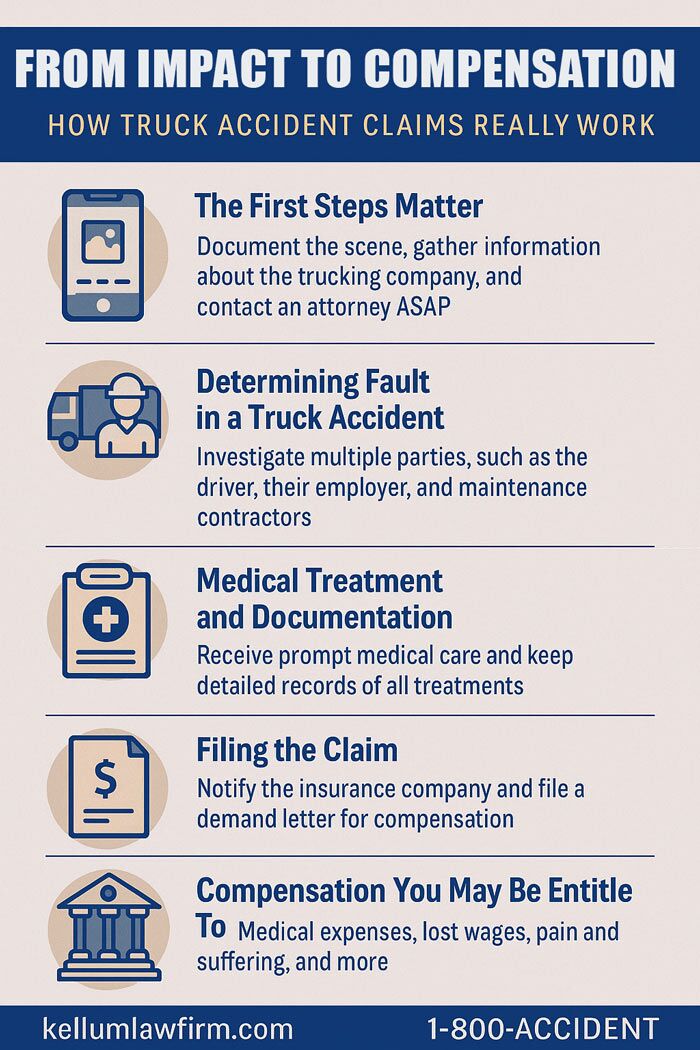
From Accident to Resolution: Understanding a Truck Injury Claim
A serious commercial truck accident claim may involve several stages, and not every case follows the same path. Understanding the general process can help injured people prepare for what comes next.
Initial Medical Care and Documentation
Appropriate medical treatment comes first. Preserve information about the crash, the vehicles involved, witnesses, and injuries when it is safe to do so.
Investigation and Evidence Preservation
Depending on the circumstances, an attorney may investigate the driver, motor carrier, vehicle condition, insurance coverage, and records relevant to the collision. Important electronic or physical evidence may require prompt preservation requests.
Evaluating Liability and Damages
The available evidence is reviewed to determine who may be legally responsible and what losses can be supported. Medical expenses, lost earnings, future treatment, and other damages may require documentation.
Insurance Negotiations
Once enough information is available to evaluate the claim, discussions with the relevant insurers may take place. A proposed settlement should be considered in light of the injuries, evidence, legal issues, and rights that would be released.
Litigation When Necessary
If the dispute cannot be resolved through negotiation, filing a lawsuit may be appropriate. Litigation can involve discovery, expert analysis, depositions, motions, and potentially a trial.
For a closer look at the legal process, read Big Rigs, Big Responsibilities: Truck Accident Lawsuits.
Questions about a collision? Request a free case evaluation.
Truck Accident Resources

Why Small Law Firms Struggle With Big Truck Accident Cases
Truck Accidents on Rural Roads in Rocky Mount, NC: Legal Steps and Safety Tips
Truck Accidents Caused by Driver Fatigue
Truck Accident and Injury Claims Comprehensive FAQ
Featured And Recognized









OUR LOCATIONS INCLUDE:
RALEIGH | NEW BERN | WILMINGTON* | JACKSONVILLE | MOREHEAD CITY | GREENVILLE | GOLDSBORO | WILLIAMSTON* | ROCKY MOUNT | ROANOKE RAPIDS* | DURHAM* | FAYETTEVILLE* | CHARLOTTE
Kellum Law Firm's corporate headquarters is located in New Bern, NC and has offices around North Carolina, including Raleigh, Greenville, Jacksonville, Wilmington, and more. We provide local residents with legal services focusing on personal injury law including automobile accidents, social security disability, workers' compensation, elder abuse, and more.